


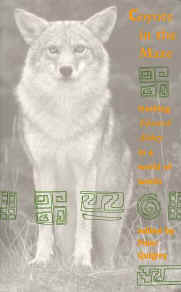
Coyote in the Maze
Tracking Edward Abbey in the World of Words (1998)
By Peter Quigley (Editor), Jim Stiles (Photographer), Stewa Cassidy
Paperback, 448 pages, Univ of Utah Press, ISBN: 0-87480-563-5
Cover text | Reviews | Table of Contents | Availability
Reader comments
Cover text
The works of Edward Abbey have been well known to general readers since the 1960s. Now an increasing interest in nature and environmental writing has focused the attention of a new generation of readers on classics such as Desert Solitaire and The Monkey Wrench Gang. This volume, the first comprehensive collection of literary criticism devoted to Abbey's challenging corpus of fiction and nonfiction, couldn't be more timely or significant.
From the perspective of his scholarly critics in Western American literature and environmental studies Ed Abbey is, in a word, a problem. As Peter Quigley, the volume editor comments, "The title of this collection refers to a number of references within Abbey's work. The maze is a place of myriad canyons, of wonder, and a place where the desperadoes in The Monkey Wrench Gang could lose the authorities. The coyote refers to the slippery figure in Native American myth, a figure, known to Abbey, that was always in between definition and could slip out of every trap set to catch him." In this long-awaited anthology, 18 intrepid scholars have chosen to ignore the coyote's reputation, tracking Abbey in one masterful and illuminating essay after another through the canyons of anarchist politics, philosophy, feminist literary criticism, post-structuralism, and rhetoric, as well as nature and environmental theory and activism.
Peter Quigley is an editor of the journal Jeffers Studies and the chair of the Humanities and Social Science Department at Embry-Riddle University where he teaches courses in literature and environmental studies in the Science, Technology, and Globalization Program.
Reviews
(none yet)
- Introduction: Heraclitean Five, Bakhtinian Laughter, and the Limits of Literary
Judgment,
Peter Quigley - Featured Forewords
Foreword I: The Roots of Abbey’s Social Critique,
Edward Twining
Foreword II: Magpie,
SueEllen Campbell - Essays
- “I’m a Humanist”: The Poetic Past in Desert Solitaire,
David J. Rothman - Who is the Lone Ranger?: Edward Abbey as Philosopher,
David Rothenberg - Nativity, Domesticity, and Exile in Edward Abbey’s “One True Home,”
Tom Lynch - Rage Against the Machine: Edward Abbey and Neo-LudditeThought,
Paul Lindholdt - Edward Abbey’s Inadvertent Postmodernism: Theory, Autobiography, and Politics,
Bill Chaloupka - Abbey as Anarchist,
Harold Alderman - Getting the Desert into a Book”: Nature Writing and the Problem of Representation
in a Postmodern World,
Claire Lawrence - Surviving Doom and Gloom: Edward Abbey’s Desert Comedies,
Rebecca Raglon - Nietzschean Themes in the Works of Edward Abbey,
Steven Norwick - Edward Abbey’s Cow, Barney Nelson1. Edward Abbey’s Cow,
Barney Nelson - Edward Abbey and Gender,
Paul T. Bryant - The Life of the Author: Emerson, Foucault, and the Reading of Edward Abbey’s
Journals,
David Copland Morris - From the Banks of the Illisus to the Arches of Utah: Edward Abbey as Noble Rhetorician,
Bryan L. Moore - Biocentrism and Green Existentialism: Conflicting Conceptualizations of Nature in Ed
Abbey,
Werner Bigell - The Politics and Aesthetics of a Hopeful Anarchism: Edward Abbey’s Postmodern
“Angelic Demonology,”
Peter Quigley - The Politics of Leisure: “Industrial Tourism” in Edward Abbey’s Desert
Solitaire,
James A. Papa Jr.
- “I’m a Humanist”: The Poetic Past in Desert Solitaire,
Availability
 |
You can now order the items listed below directly via the Internet from the Abbey's Web Bookstore in affiliation with Amazon.com
Books. Please read the instructions for more
information, or select one of the following:
|
Why ads for Amazon?